EU municipal waste management: 2024 data
The latest Eurostat data confirms that the European Union continues to move progressively away from landfill disposal and towards more diversified waste treatment systems aligned with circular economy objectives. Nevertheless, significant disparities between Member States remain, underlining the uneven pace of transition across Europe.
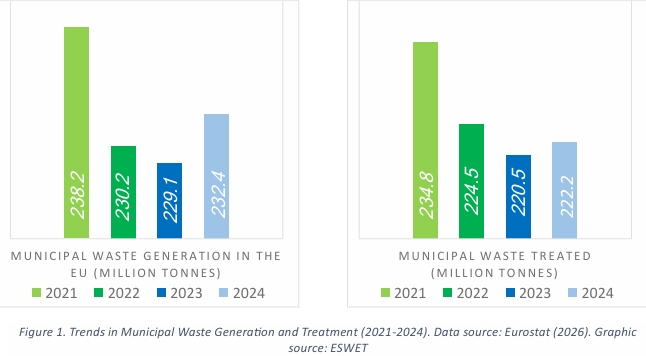
According to the latest data published by Eurostat, in 2024 the EU generated approximately 232.4 million tonnes of municipal waste, a slight increase compared to 2023 but still below the 2021 peak of 238.2 million tonnes. Of this, around 222.2 million tonnes were treated, including through recycling, Waste-to-Energy (WtE), landfilling, and other recovery operations.
 Overview of waste volumes per waste treatment:
- Recycling accounted for 111.7 million tonnes of treated municipal waste in 2024, representing a slight increase compared to the 110.0 million tonnes recycled in 2023.
- Waste-to-Energy treatment also increased, rising from 56.8 million tonnes in 2023 to 59.2 million tonnes in 2024.
- Landfilling continued its downward trend, decreasing from 51.4 million tonnes in 2023 to 49.5 million tonnes in 2024.
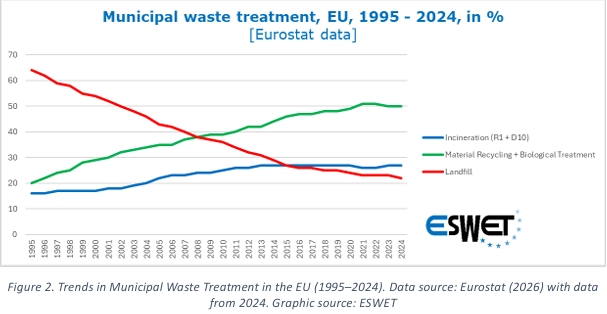 The figure above illustrates the long-term shift in municipal waste management across the EU. Over the past three decades, landfilling has declined dramatically (from more than 60% of municipal waste in 1995 to 22.5% in 2024) while recycling and energy recovery have steadily expanded. This evolution reflects the combined impact of EU waste legislation, landfill restrictions, recycling targets, and investments in alternative waste treatment infrastructure.
The data demonstrates that recycling and WtE are complementary strategies that together support the diversion of waste away from landfill, contributing to a more sustainable circular economy. While recycling remains the preferred option for recoverable materials, WtE provides environmentally controlled treatment for residual, non-recyclable waste that would otherwise be landfilled. Together, recycling and WtE now account for more than three quarters of treated municipal waste in the EU.
Recycling stabilises above 50%
Recycling remained the EU’s primary municipal waste treatment option in 2024, accounting for 111.7 million tonnes of treated waste. While this confirms the high level of material recovery achieved across the Union, recycling rates have largely stabilised in recent years, suggesting that further progress may become increasingly difficult without additional structural reforms and investment. The stabilisation of EU recycling rates highlights persistent challenges identified in ongoing EU circular economy discussions, including sorting quality, separate collection performance, market demand for secondary raw materials, and uneven implementation of Extended Producer Responsibility (EPR) schemes across Member States.
Waste-to-Energy continues to support landfill diversion
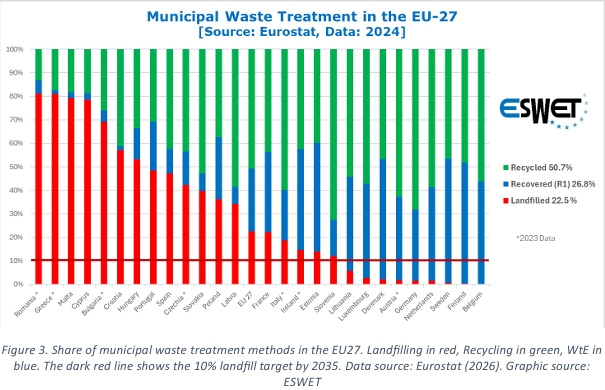
Waste-to-Energy maintained a central role in the treatment of non-recyclable residual waste in 2024. Approximately 59.2 million tonnes of municipal waste were treated through R1 recovery operations, representing 26.8% of total treated waste, a moderate increase compared to previous years. The experience of countries such as Sweden, Denmark, Finland and the Netherlands demonstrates that high recycling rates can coexist with extensive energy recovery infrastructure. These Member States combine strong recycling performance with very low landfill dependency, illustrating how WtE functions most effectively as part of a broader system prioritising waste prevention, material recovery and circularity.
 At EU level, the role of WtE continues to feature prominently in ongoing policy discussions, including debates on the revision of the EU Emissions Trading System (ETS), implementation of the Industrial Emissions Directive (IED 2.0), and the future Circular Economy Act.
Landfilling declines further, but major disparities persist
Landfilling continued its long-term decline in 2024, falling to 49.5 million tonnes, equivalent to 22.5% of treated municipal waste in the EU. Although this represents further progress towards EU waste hierarchy objectives, the pace of reduction remains insufficient in several Member States. Countries including Romania, Greece, Malta, Cyprus and Bulgaria still landfill the majority of their municipal waste, in some cases exceeding 70–80%. These figures illustrate the scale of investment and structural reform still required to meet the EU target of reducing municipal waste landfilling to a maximum of 10% by 2035.
A continuing transition towards circularity
The latest Eurostat figures confirm that Europe’s waste management transition continues to advance, even if unevenly. While recycling remains the cornerstone of circular economy policy, the data also highlights the continued necessity of Waste-to-Energy for the treatment of residual waste and for reducing dependence on landfill disposal. Future progress will increasingly depend on measures higher up the waste hierarchy, including waste prevention, eco-design, mandatory recycled content requirements, harmonised End-of-Waste criteria, and stronger markets for secondary raw materials. At the same time, maintaining diversified and integrated waste treatment systems will remain essential to achieving the EU’s environmental, climate and resource efficiency objectives. In this context, ongoing discussions at EU level continue to highlight the need for greater recognition of the role of Waste-to-Energy in treating non-recyclable waste, supporting landfill diversion, and contributing to Europe’s energy and raw material resilience and security.